Create your profile, save bookmarks & likes
hoverstate.design

14 Best Portfolio Websites for Designers & Developers in 2026

The best portfolio sites don't follow a template. Some are interactive experiments. Some are just text on a white background. What they share: clarity about who the person is and what they can do. This list covers real examples from designers and developers worth studying, plus the best tools to build your own.

By Shahriyar Ishmam · Last updated: October 2026 · 14 portfolios & tools

Interactive & creative dev portfolios

1.Bruno Simon

Creative developer & Three.js educator

Visit →

The entire portfolio is a 3D driving game built in Three.js — you drive a toy car through a world that contains his work. It has been cited as one of the most influential portfolio sites ever made. Not because everyone should copy it, but because it proved a portfolio can be the product.

Approach: Portfolio as interactive experience — the site IS the demonstration of skill
2.Rauno Fäderholm

Design engineer at Vercel

Visit →

A minimal personal site from one of the most respected design engineers in the industry. Clean typography, subtle interactions, and a focus on the work over personality. The hover states and micro-interactions throughout demonstrate exactly the craft he is known for.

Approach: Let the interactions demonstrate the skill — every detail is the portfolio

3.Emil Kowalski

Design engineer

Visit →

Emil's portfolio focuses on UI interactions and animations. The site itself showcases the quality of his work through its own interactions. His projects section includes open-source libraries (like vaul) that have genuine GitHub traction.

Approach: Interactions as proof of work, open-source contributions as credibility

Minimal & writing-focused portfolios

4.Paco Coursey

Software engineer, previously at Vercel

Visit →

One of the cleanest developer portfolios on the internet. Text-first, fast, and focused on writing and projects rather than a hero section. The dark mode toggle animation became widely copied. Demonstrates that developer portfolios don't need design flair — they need clarity.

Approach: Text-first, writing over hero sections, speed as a signal

5.Lynn Fisher

Designer and creative developer

Visit →

Lynn rebuilds her portfolio from scratch every year with a completely different concept, often using CSS art. Each version is documented as a case study. The commitment to an annual reinvention is itself a powerful signal of creativity and craft.

Approach: Annual rebuild as process documentation — the reinvention is the portfolio

6.Josh Comeau

Developer educator & interactive blog author

Visit →

Josh's site is a blog with interactive explanations embedded in every post. The portfolio is really a proof of teaching skill — if you can read his CSS or animation posts and understand them, you understand the value he provides. The blog is the product.

Approach: Teaching as portfolio — interactive blog posts demonstrate depth and communication

10.Manu Moreale

Indie designer and writer

Visit →

An intentionally simple portfolio that prioritizes writing and making over visual flair. Fast, no JS, no tracker. A quiet counterargument to over-designed portfolios — proves that consistent output and clear thinking are more persuasive than animations.

Approach: Anti-trend: no JS, no tracker, writing as portfolio, speed as philosophy

Case study & process portfolios

7.Tobias van Schneider

Designer, former Spotify lead

Visit →

A case study-heavy portfolio from a senior design leader. Projects are presented with context, constraints, and outcomes — not just screenshots. The writing is direct and shows strategic thinking. Aimed at clients and creative leadership, not entry-level hiring managers.

Approach: Context-constraint-outcome case study format, strategic framing over visual screenshots

8.Femke van Schoonhoven

Senior product designer

Visit →

A product designer portfolio with detailed process documentation. Each case study covers the problem, research, iterations, and shipped outcome. The writing is clear and non-jargon. Strong for demonstrating UX thinking and collaboration skills to product design hiring teams.

Approach: Process-forward case studies, research documentation, collaboration evidence

9.Rogie King

Designer & illustrator

Visit →

Rogie's portfolio leads with illustration and personality. The site itself is highly illustrative with custom cursor interactions. A strong example of a designer whose personal brand IS their work — the aesthetic is immediately distinctive and self-consistent.

Approach: Personal brand as portfolio — aesthetic identity communicates style before any project

Tools to build your portfolio

Framer

11.Framer

Portfolio builder (no-code)

View on Hoverstate →

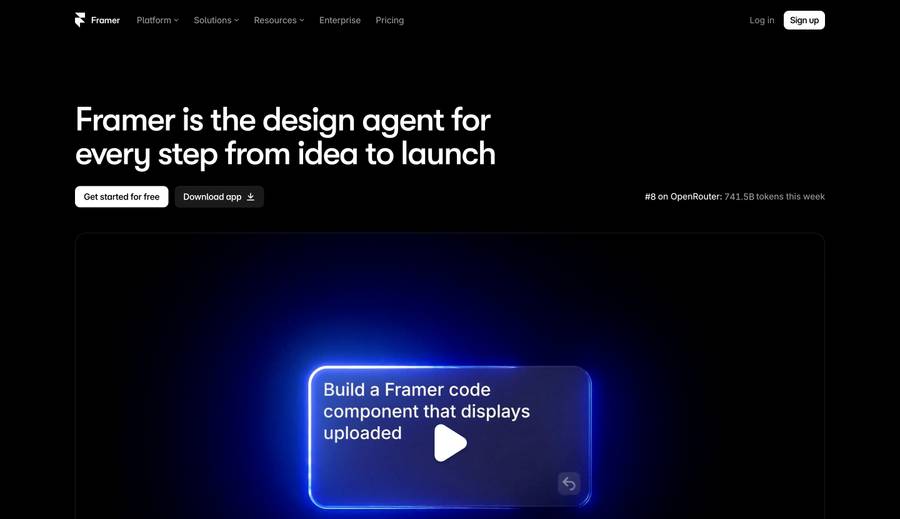
Framer is the most capable no-code portfolio builder for designers in 2026. You can build a fully custom site without touching code, deploy on a custom domain, and iterate fast. The template marketplace includes high-quality portfolio starting points designed to actually convert.

Approach: Fastest path from design file to live portfolio with genuine customization

12.Readymag

Portfolio and magazine builder

Visit →

Readymag sites have a distinct typographic and editorial character. The builder is built for designers who care about typography and layout precision. Less flexible than Framer but with a higher floor — hard to make a Readymag site look bad.

Approach: Highest floor for editorial/typographic portfolio design without code

13.Cargo

Portfolio and artist site builder

Visit →

Cargo has been the home of art directors, illustrators, and photographers for over a decade. The community attracts serious visual artists. The builder has an unconventional UI that rewards exploration. Portfolio aesthetics on Cargo tend toward experimental and editorial.

Approach: Community-driven discovery, experimental aesthetic palette, art director credibility

14.Contra

Portfolio and freelance platform

Visit →

Contra combines a portfolio builder with a freelance marketplace — you publish your work and clients can hire you directly. The portfolio pages are clean and well-structured. A practical option for freelancers who want their portfolio to generate inbound directly.

Approach: Portfolio-to-hire pipeline, embedded client discovery, zero commission

Frequently Asked Questions

What should a designer's portfolio website include?+

A strong designer portfolio needs: 3–5 case studies with problem context and outcome (not just screenshots), a clear 'about' statement with your specialty and experience level, contact information or a booking link, and fast load time. Less is more — 3 great case studies beat 10 mediocre ones. Each case study should cover the problem you were hired to solve, your role and constraints, the key decisions you made and why, and the measurable outcome. Hiring teams skim portfolios in under two minutes — make the headline of each case study instantly clear about what you did and for whom.

What should a developer's portfolio website include?+

For developers: a list of projects with links to live sites and GitHub repos, the technologies used, and a brief description of what was technically interesting. A blog with even a few technical posts adds significant credibility. Paco Coursey and Josh Comeau are the most-studied references. The blog matters because it demonstrates that you can explain your thinking, not just write the code. Even three well-written posts on specific technical decisions carry more weight than a generic list of technologies. Keep the project list short — five strong projects with real users beat twenty side projects no one uses.

What's the best tool to build a portfolio website without code?+

Framer is the most capable no-code option for designers in 2026. It supports full custom design, animations, and custom domains. Readymag is better if your work is editorial or typographic. Cargo suits artists and illustrators. Contra is best if you want the portfolio to also generate freelance work. If you already have a Figma design, Framer's import tool can translate it into a live site faster than any other tool. The key differentiator versus Squarespace or Wix is that Framer treats the portfolio like a design file — you control every pixel.

How long should a portfolio case study be?+

Long enough to show your thinking, short enough to respect the reader's time. The best case studies take 3–5 minutes to read. Cover: the problem, your role, key decisions and why, and the outcome. Femke van Schoonhoven's case study format is widely used as a reference. A common mistake is writing too much backstory and too little decision rationale — hiring managers want to understand how you think, not the full history of the project. Aim for 600–900 words per case study with at least three supporting visuals: a problem frame, a process or iteration shot, and the final delivered design.

Where can I find portfolio website inspiration?+

Awwwards and Hoverstate both include portfolio sites. Awwwards skews toward experimental creative developer work. Hoverstate's gallery covers a broader range of real production portfolios and lets you filter by technology stack — useful if you want to see what Framer or Webflow portfolios look like. For OG image inspiration specifically — since your portfolio link gets shared in Slack and on Twitter — see the dedicated OG image examples page, which covers patterns for personal site previews alongside SaaS and product OG images.

How should a portfolio website handle mobile?+

Mobile matters more for portfolios than most designers expect — a significant share of recruiters and clients first see your portfolio on a phone. The most common failure is a hero image or case study layout that looks great at 1440px but collapses on mobile. Test every page at 375px and 430px width before publishing. Framer and Readymag both have responsive breakpoint tools that make this easier than building a custom mobile layout from scratch.

Related design inspiration

Find portfolio inspiration on Hoverstate

Browse thousands of real websites — including portfolios — filtered by category, industry, or technology stack.

Loading…